
What is thirdhand smoke?
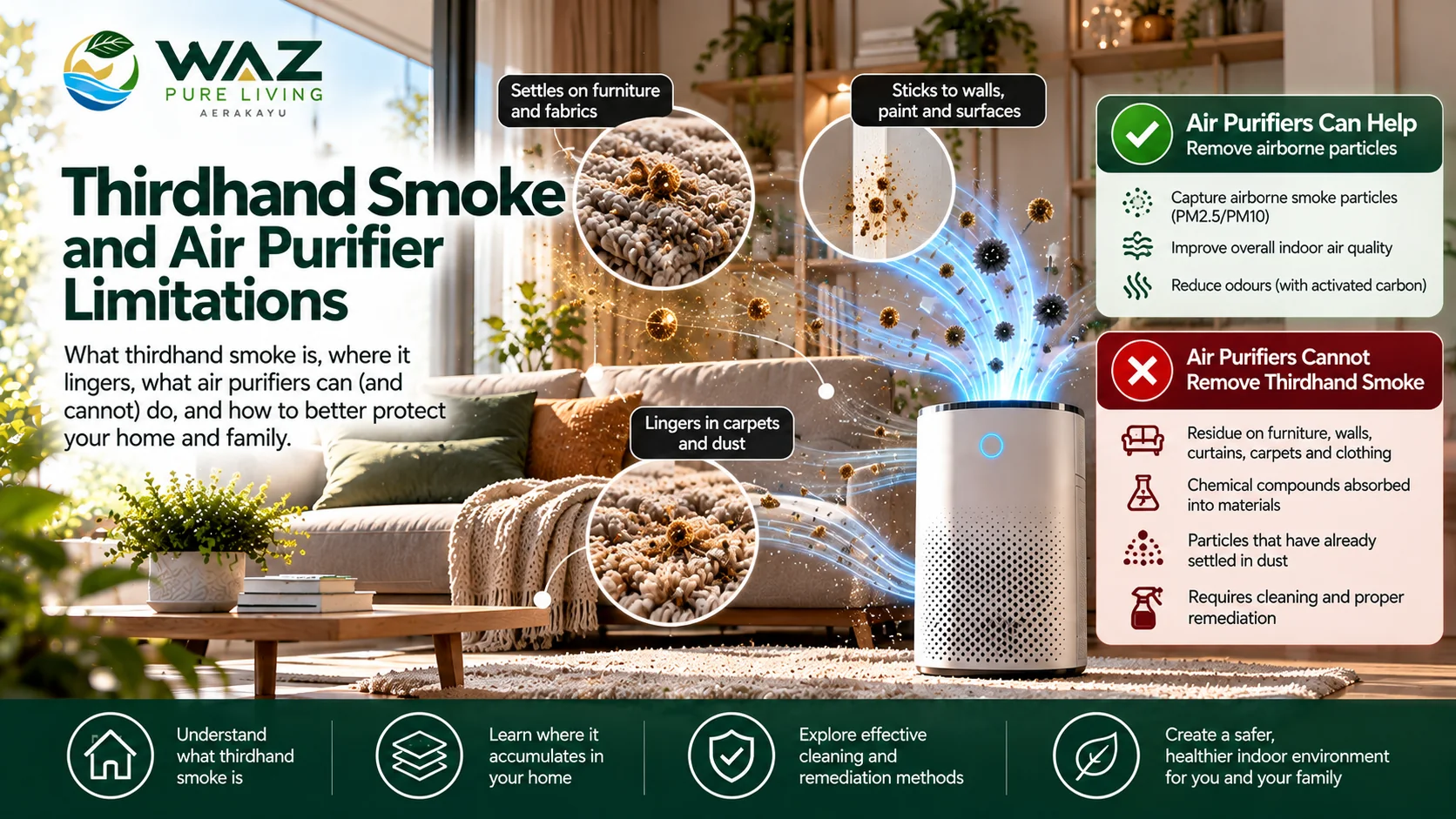
Thirdhand smoke is contamination left behind after tobacco smoke has cleared. Nicotine and other chemicals can settle on walls, furniture, carpets, curtains and dust; some are absorbed into materials and later released or chemically transformed.
A 2026 systematic review found that surface nicotine is a useful marker of this persistent contamination. The smell of a room is not a reliable test of whether residues remain.
What an air purifier can reduce
A suitable particle-filtering air purifier may reduce airborne tobacco-smoke particles while they remain suspended, and particles that become resuspended later. A properly designed activated-carbon stage may reduce some airborne gases and odours, depending on the compound and filter capacity.
Neither capability means the device can extract nicotine embedded in paint, upholstery or porous materials. A clean PM2.5 reading does not demonstrate that thirdhand smoke contamination has been removed.
Why surface cleaning matters
The first priority is a smoke-free indoor environment. Clean washable textiles according to their care instructions; damp-wipe hard surfaces using suitable products; and vacuum with an effective particulate filter to limit dust redistribution.
Heavy or long-standing contamination may require professional assessment, replacement of porous materials, or more extensive remediation. Avoid mixing cleaning chemicals and do not rely on ozone generators: ozone can create additional indoor reaction products.
What households should remember
Young children may have greater contact with floors, dust and furnishings. Preventing indoor smoking is much easier than remediating a heavily contaminated home. Ventilation and filtration are useful complements, not substitutes for cleaning contaminated surfaces.
Evidence about individual long-term health outcomes from thirdhand smoke is still developing. That uncertainty should not be confused with absence of residue or proof that a purifier eliminates exposure.
Practical checklist
Check the pollutant you want to reduce, select an appropriate control method, and verify any model-specific performance claims with documentation. Source control and suitable ventilation remain essential.
Continue learning
Sources & further reading
- ACS ES&T Air — Thirdhand Tobacco Smoke: A Systematic Review (2026)
- Lawrence Berkeley National Laboratory — Quantitative reference levels for thirdhand smoke residue (2026)
- U.S. EPA — Guide to Air Cleaners in the Home
This educational guide is not medical advice or evidence of performance by a specific AERAKAYU model. Illustrations are conceptual, not laboratory test results.
Evidence first: choose clean-air solutions based on the pollutant, independent testing and the room where they will be used.
Talk to our team →