
What is a Corsi–Rosenthal box?
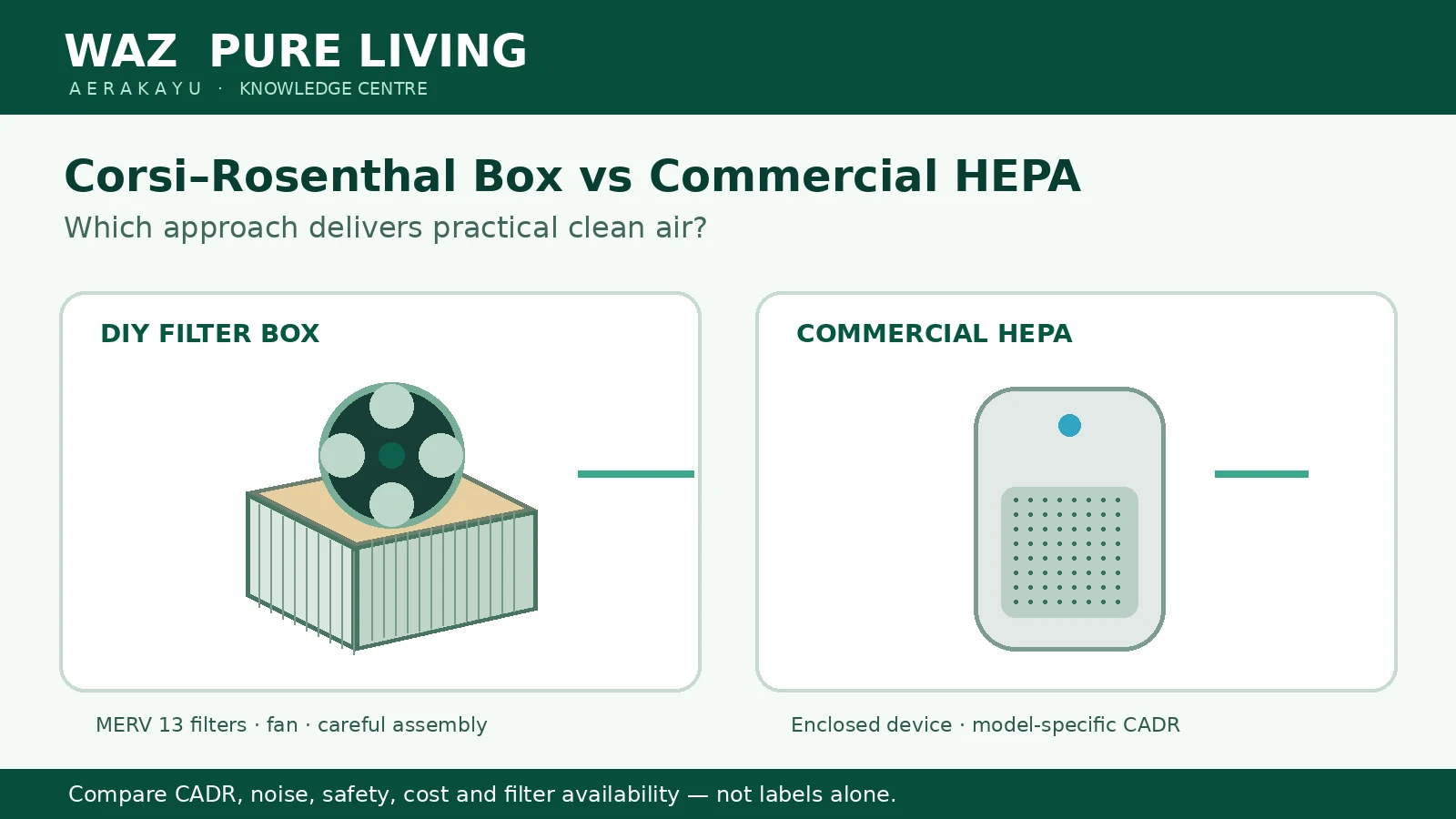
A Corsi–Rosenthal box is a do-it-yourself air cleaner usually assembled from four high-efficiency HVAC filters, a box fan, cardboard and tape. Air is drawn through the filters and expelled by the fan. It was popularised as an accessible way to increase indoor particle removal.
Many builds use MERV 13 filters, which are not identical to HEPA filters. A good multi-filter design can still achieve substantial clean-air delivery because large filter area and airflow matter, not just a filter-grade label.
Compare delivered clean air, not labels alone
The useful metric for particle cleaning is clean air delivery rate (CADR), together with room volume, operating speed and placement. Independent tests show that some DIY configurations perform very well, but results vary by fan, filter, sealing and construction quality.
Commercial purifiers may provide verified CADR, enclosed fan guards, speed controls, sensors, warranty and predictable replacement parts. They are not automatically better: a small unit on quiet mode may deliver less clean air than a well-built DIY box.
Noise, electricity and maintenance
Consider noise at the speed you will actually use. A box fan may be louder or less convenient than a purpose-built purifier; some modern commercial units also become noisy at maximum speed. Measure or compare like-for-like conditions where possible.
Both types need regular inspection and filter replacement. DIY filters must be installed in the correct airflow direction, sealed well and kept dry. Costs should include replacement filters, electricity and time—not just the initial purchase.
Safety and practical fit in Indonesia
Use a modern, safety-certified fan appropriate for local voltage and frequency, with intact wiring and a secure guard. EPA advises newer box fans with recognised safety certification and warns against unattended use of older fans. Keep assemblies away from water, children and obstructions.
In Indonesia, check whether suitable MERV 13 filters and compatible fans are consistently available. Neither DIY boxes nor standard HEPA purifiers replace ventilation, remove CO₂, or reliably control every gas. Choose the option you can operate safely and maintain consistently.
Practical checklist
Check the pollutant you want to reduce, select an appropriate control method, and verify any model-specific performance claims with documentation. Source control and suitable ventilation remain essential.
Continue learning
Sources & further reading
- National Collaborating Centre for Environmental Health — DIY Air Cleaners Evidence Review
- U.S. EPA — Air Cleaners, HVAC Filters and Coronavirus
- U.S. EPA — Guide to Air Cleaners in the Home
This educational guide is not medical advice or evidence of performance by a specific AERAKAYU model. Illustrations are conceptual, not laboratory test results.
Evidence first: choose clean-air solutions based on the pollutant, independent testing and the room where they will be used.
Talk to our team →