
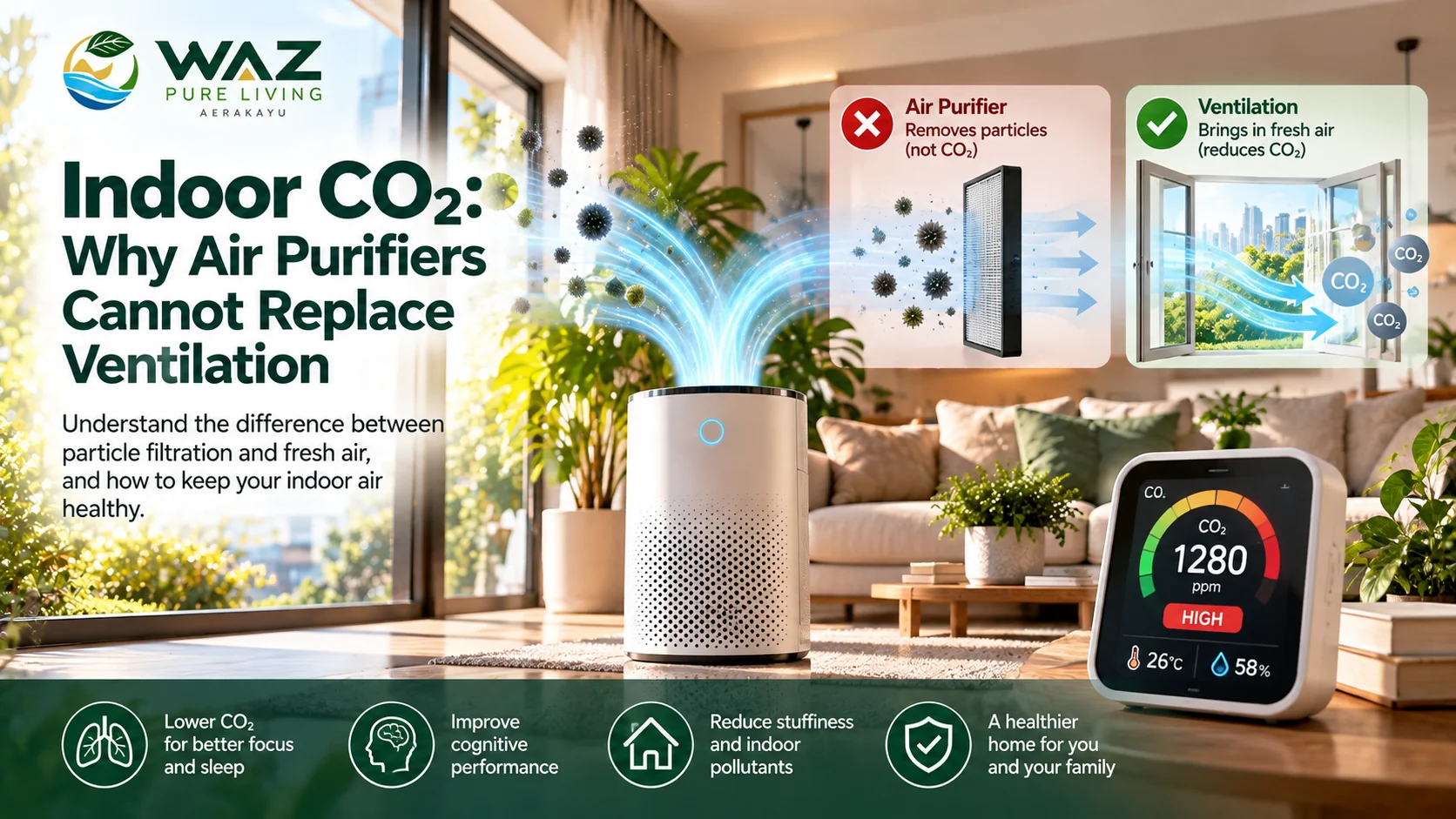
Why CO₂ rises in occupied rooms
People exhale carbon dioxide (CO₂). In a closed or poorly ventilated room, CO₂ can accumulate as occupants continue breathing. The reading often helps indicate whether outdoor-air supply is adequate for the number of people present, although it is not a complete measure of indoor air quality.
A single number does not diagnose illness or prove that a room is unsafe. Interpret readings with occupancy, sensor accuracy, outdoor conditions and trends over time. A portable nondispersive infrared (NDIR) CO₂ monitor is generally more useful than an estimated CO₂ value derived from a VOC sensor.
What a HEPA purifier does—and does not do
HEPA filtration removes particles from the air flowing through the device. Ordinary HEPA purifiers do not supply outdoor air and do not remove CO₂. A purifier can make particle readings improve while a closed room remains poorly ventilated.
Activated carbon can help with certain gases and odours if the filter is designed and sized for them, but ordinary household carbon cartridges should not be assumed to capture meaningful amounts of CO₂.
Ventilation and filtration work together
Ventilation exchanges indoor air with outdoor air, diluting occupant-generated CO₂ and many indoor contaminants. Open windows where outdoor air is suitable, or use a correctly designed mechanical fresh-air system. In polluted outdoor conditions, filter incoming air where practical.
Recirculating air conditioning is not necessarily ventilation: many split AC systems cool and recirculate indoor air without adding meaningful outdoor air. Check the actual fresh-air provision rather than relying on the AC label.
Practical steps for Indonesian homes and offices
Use a reliable CO₂ monitor to spot sustained rises during meetings, sleeping or crowded periods. Improve fresh-air exchange where appropriate, reduce overcrowding, and verify airflow rather than chasing a universal ppm target without context.
Keep particle filtration running when it is useful, especially during haze or traffic pollution. Ventilation decisions should consider outdoor PM2.5, humidity, heat and building safety. The goal is cleaner air and adequate fresh-air supply together.
Practical checklist
Check the pollutant you want to reduce, select an appropriate control method, and verify any model-specific performance claims with documentation. Source control and suitable ventilation remain essential.
Continue learning
Sources & further reading
- University of Melbourne — Frequently asked questions about air cleaners
- U.S. EPA — Indoor Air and Coronavirus (COVID-19)
- CDC — Ventilation in Buildings
This educational guide is not medical advice or evidence of performance by a specific AERAKAYU model. Illustrations are conceptual, not laboratory test results.
Evidence first: choose clean-air solutions based on the pollutant, independent testing and the room where they will be used.
Talk to our team →