
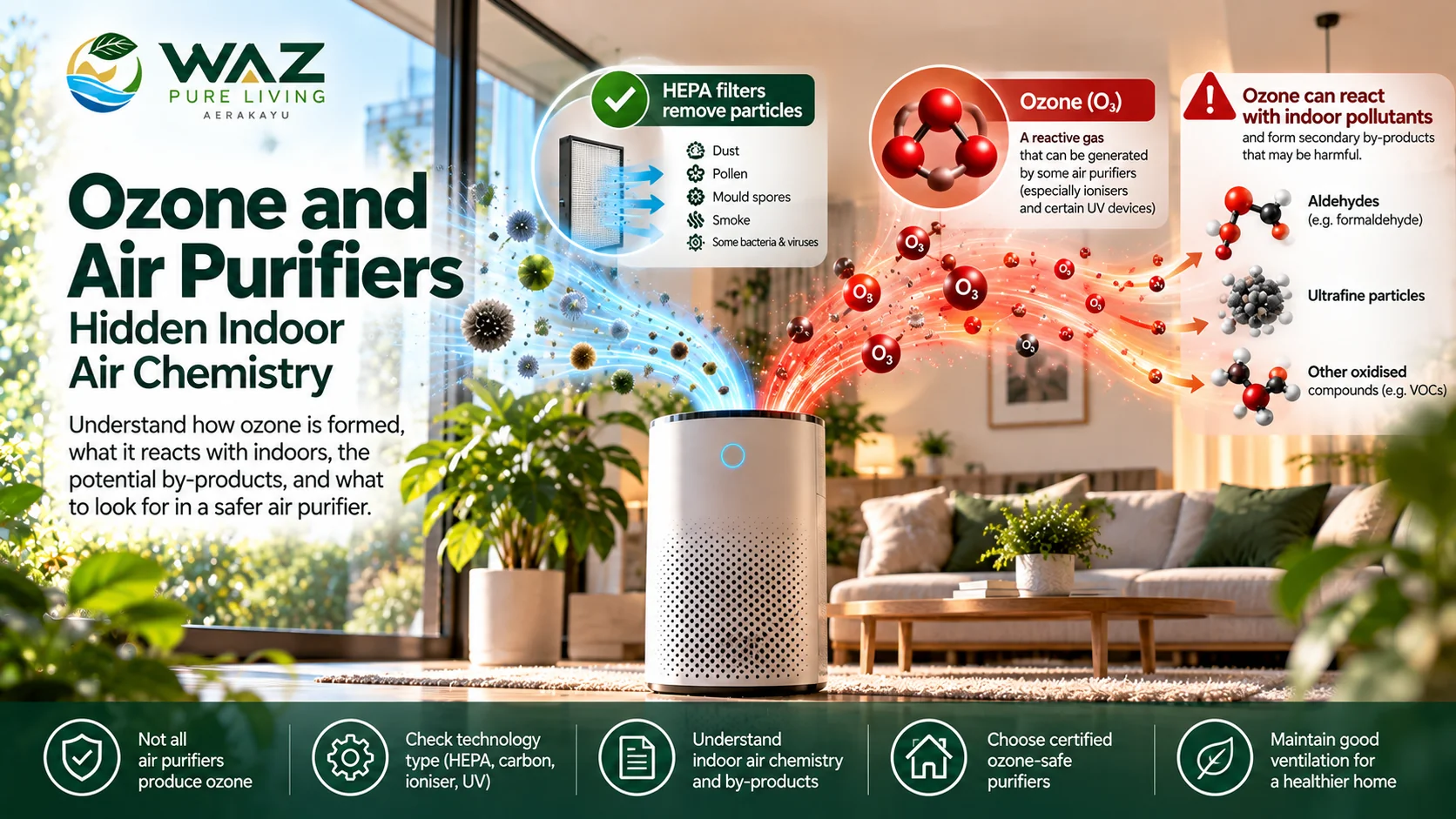
Ozone is not the same as oxygen
Oxygen that we breathe is O₂; ozone is O₃, a more reactive gas. Ground-level ozone can irritate the respiratory system. Deliberately generating ozone inside occupied rooms is not a safe substitute for conventional particle filtration and source control.
A conventional mechanical HEPA filter does not need ozone to trap particles. Some ionisers, electrostatic systems and certain UV devices may generate ozone depending on their design and operating conditions; the label alone does not establish emissions.
Why secondary chemistry matters
Ozone can react with chemicals released by cleaning products, fragrances, surfaces and furnishings. These reactions may generate formaldehyde, other aldehydes, organic acids and ultrafine particles. A room may therefore experience new pollutants even if some original odours change.
The specific reaction products depend on the mixture of chemicals, humidity, ventilation and ozone concentration. A claim that a device “neutralises odours” does not prove that the resulting indoor air is safer.
How to evaluate air-cleaning technologies
For particles, prioritise independent whole-device CADR information, suitable room size and filter maintenance. If a device includes ionisation, plasma, UV or another electronic process, ask for credible ozone-emission testing for the exact model and operating mode.
Be cautious of vague “medical grade,” “chemical-free sterilisation” or “ozone-safe” claims without traceable testing. EPA does not certify air-cleaning devices, and an EPA establishment number is not product approval.
A sensible clean-air strategy
Reduce indoor emission sources, ventilate appropriately and use effective mechanical filtration for particles. If gas removal is needed, evaluate sorbent type, quantity, replacement interval and independent evidence for the target contaminant.
Do not operate ozone generators in occupied rooms. Product-level claims for AERAKAYU should only be made when relevant model-specific test reports are available.
Practical checklist
Check the pollutant you want to reduce, select an appropriate control method, and verify any model-specific performance claims with documentation. Source control and suitable ventilation remain essential.
Continue learning
Sources & further reading
- U.S. EPA — Ozone Generators That Are Sold as Air Cleaners
- U.S. EPA — Residential Air Cleaners: A Technical Summary
- U.S. EPA — What are ionizers and other ozone generating air cleaners?
This educational guide is not medical advice or evidence of performance by a specific AERAKAYU model. Illustrations are conceptual, not laboratory test results.
Evidence first: choose clean-air solutions based on the pollutant, independent testing and the room where they will be used.
Talk to our team →