
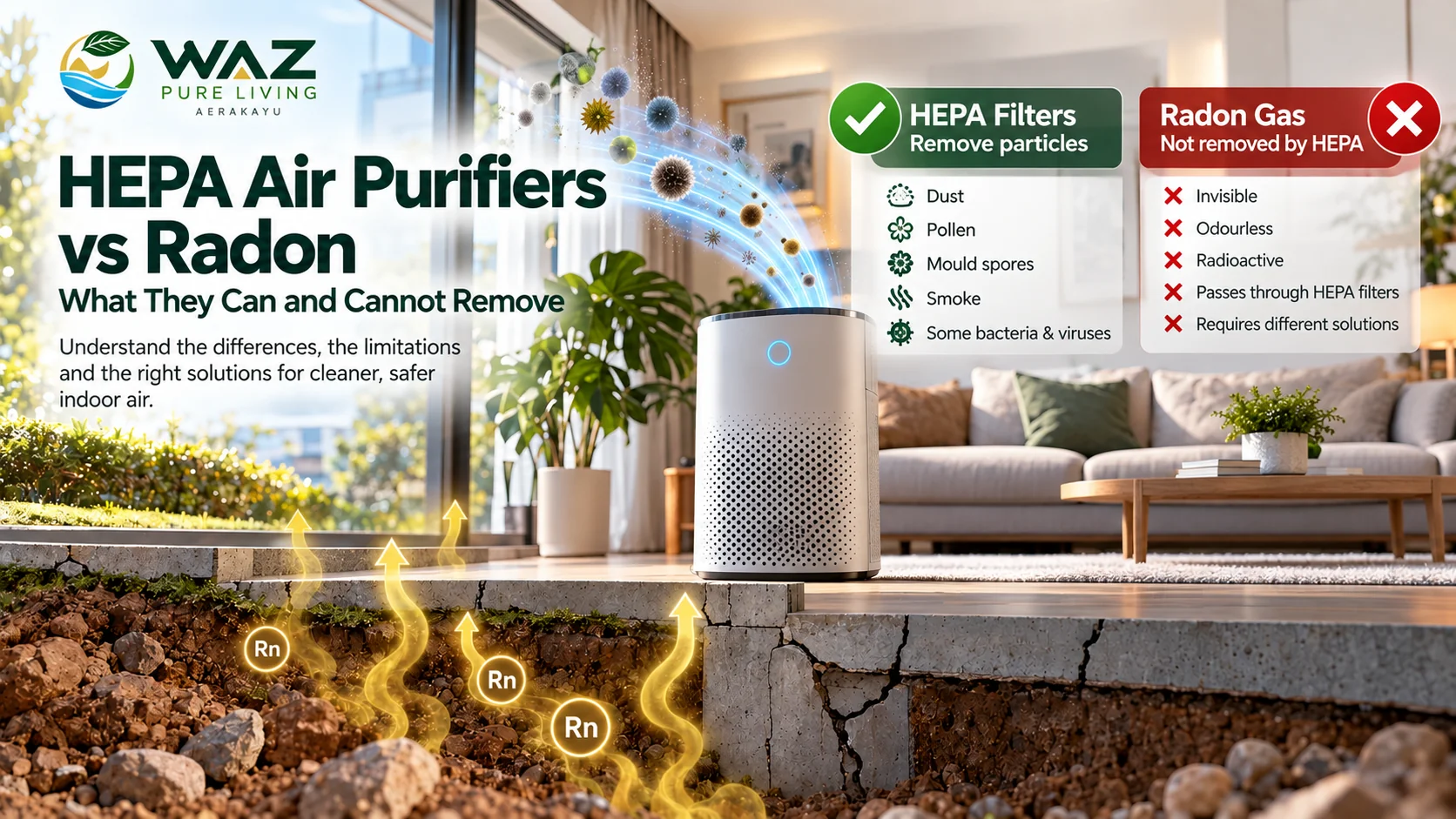
The crucial difference: particles versus gas
A HEPA filter is designed to capture particles moving through it, such as fine dust, pollen and some smoke aerosols. Radon (Rn-222) is a radioactive gas that can enter buildings from the ground. A particle filter cannot trap individual radon gas molecules.
Radon can decay into radioactive particles known as progeny, some of which may attach to airborne dust. Filtration may influence airborne progeny, but that is not the same as removing radon gas or demonstrating reduced radon-related health risk.
Why radon matters indoors
Radon is invisible and has no smell. Long-term inhalation increases lung-cancer risk; smoking and radon exposure together create particularly high risk. A room can look and smell clean while radon remains present.
Levels vary with local geology, construction and ventilation. Do not infer the concentration in an Indonesian home from its appearance, location or the presence of an air purifier. Only an appropriate radon test can establish the level.
What to do instead of relying on HEPA
If radon is a concern, use a suitable radon detector or qualified testing service, follow the recommended sampling period and interpret results against locally applicable guidance. Consumer PM2.5 sensors and typical air-purifier displays do not measure radon.
Where elevated radon is confirmed, consult a qualified building specialist about source-specific mitigation, such as sub-slab depressurisation in suitable buildings, sealing as a supporting measure, and ventilation where appropriate. Solutions depend on building design.
Where an air purifier still helps
A correctly sized, properly operated particle-filtering purifier can reduce airborne particles from outdoor pollution and some indoor sources. Compare verified CADR, noise, filter replacement and real-room operation rather than assuming a HEPA label solves every pollutant.
The practical rule is simple: use filtration for particles, testing for radon, and suitable building mitigation if radon levels warrant it. These are complementary actions, not interchangeable technologies.
Practical checklist
Check the pollutant you want to reduce, select an appropriate control method, and verify any model-specific performance claims with documentation. Source control and suitable ventilation remain essential.
Continue learning
Sources & further reading
- U.S. EPA — Will air cleaners reduce health risks?
- U.S. EPA — A Citizen’s Guide to Radon
- WHO — Radon and health
This educational guide is not medical advice or evidence of performance by a specific AERAKAYU model. Illustrations are conceptual, not laboratory test results.
Evidence first: choose clean-air solutions based on the pollutant, independent testing and the room where they will be used.
Talk to our team →