
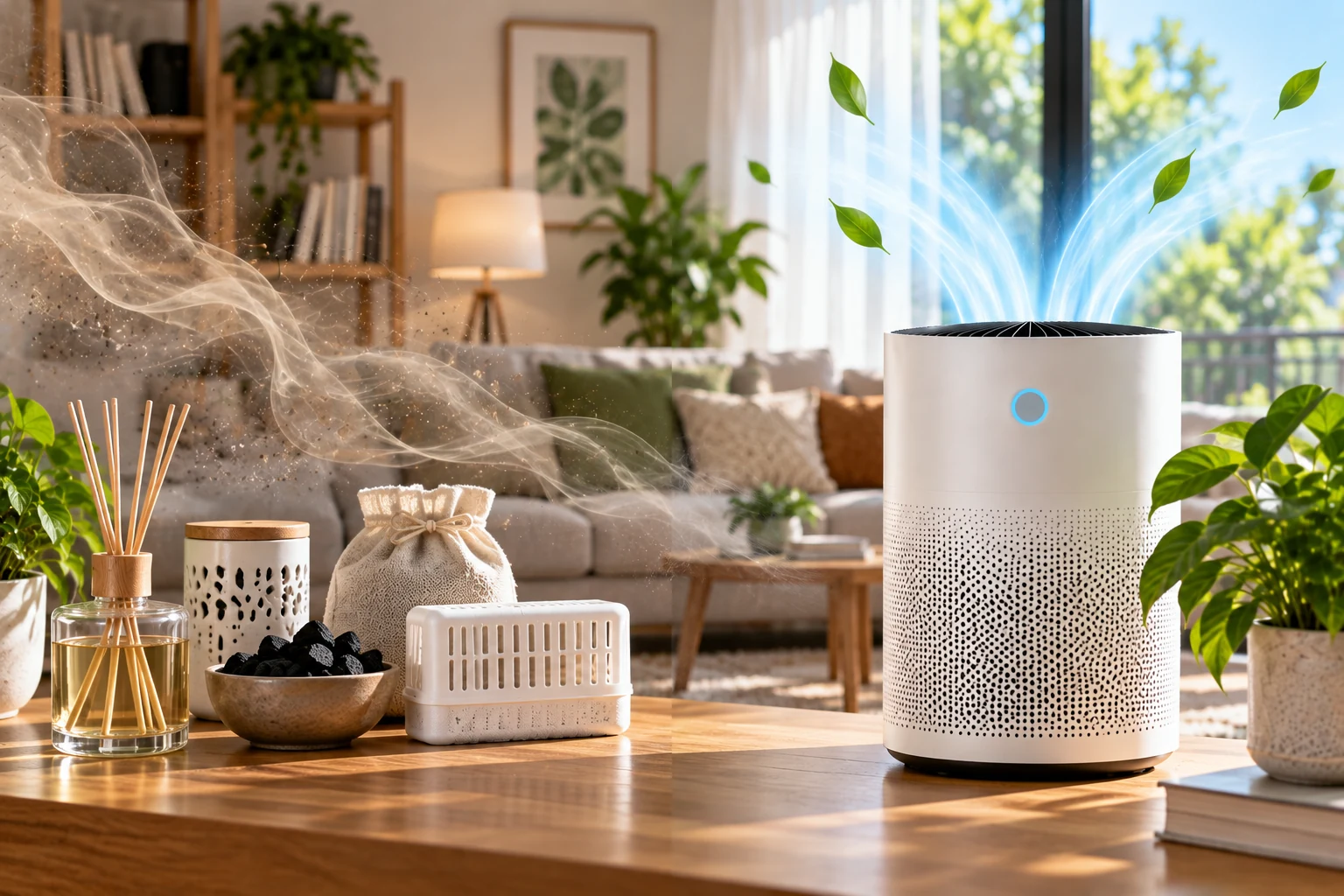
Why passive formaldehyde products deserve scrutiny
Passive products are attractive because they promise air cleaning without fans, electricity or noise. But laboratory removal rates and marketing claims do not automatically predict what happens in an occupied-scale room where ventilation, surfaces and competing chemicals affect indoor air.
The 2026 study tested five commercial products in an office
Researchers from institutions in China evaluated five passive formaldehyde-removal products in an unoccupied office under realistic conditions. The room was mechanically ventilated, and the team continuously measured formaldehyde and a wide range of volatile organic compounds while the products were deployed.
None measurably reduced formaldehyde under the tested conditions
The central result was striking: none of the five products measurably reduced formaldehyde concentration in the real-office experiment. The authors concluded that manufacturer-claimed removal efficiencies can substantially overestimate real-world performance.
Some products introduced additional VOC emissions
The researchers also observed substantial VOC emissions from some products. For example, a terpene-claimed product emitted 192 micrograms of VOCs per gram of product consumed, while a titanium-dioxide-based product emitted 155 micrograms per gram. Signals associated with compounds including benzene, toluene and styrene were detected. This does not mean every passive product emits the same compounds, but it shows why unintended emissions need to be tested rather than assumed away.
Formaldehyde is a gas: particle filters alone are not the answer
HEPA filtration is designed for particles, not gaseous formaldehyde. Gas-phase control requires a different strategy, which can include source reduction, appropriate ventilation and sufficiently engineered sorbent or reactive media. The amount of media, contact time, airflow and breakthrough behaviour all matter.
What consumers should ask before trusting an air-cleaning claim
Ask whether the claim was demonstrated for the complete product, at realistic room scale, at relevant pollutant concentrations and over a meaningful duration. Also ask whether secondary emissions were measured. A large percentage removal in a small chamber is not automatically equivalent to useful performance in a home.
Why AERAKAYU will separate particle and gas claims
WAZ Pure Living intends to describe particle filtration, odour control and gas-phase performance separately and only where the selected AERAKAYU configuration and evidence support the claim. This avoids implying that one filter technology solves every indoor-air problem.
Frequently asked questions
Did the five passive products remove formaldehyde?
Not measurably under the real-office conditions tested in the 2026 study.
Can a HEPA filter remove formaldehyde?
HEPA filters are designed to capture particles. Formaldehyde is a gas and requires appropriate gas-phase control rather than HEPA filtration alone.
Why do secondary VOC emissions matter?
An air-cleaning product should not solve one problem by introducing another. Testing for unintended emissions is therefore an important part of evaluating gas-cleaning technologies.
Continue learning
Sources & further reading
- ACS ES&T Air — Real-World Performance of Commercial Passive Formaldehyde Removal Products — 2026 real-office evaluation of five commercial passive formaldehyde-removal products and their VOC emissions.
- U.S. EPA — Guide to Air Cleaners in the Home — Background guidance on particle filtration, gas removal and indoor-air management.
Research summaries are educational and do not constitute medical advice or a product-performance claim for any AERAKAYU model.
Explore evidence-led indoor-air guidance in the WAZ Pure Living Knowledge Centre. AERAKAYU product claims will be introduced only as individual model specifications and supporting documentation are verified.
Talk to our team →