
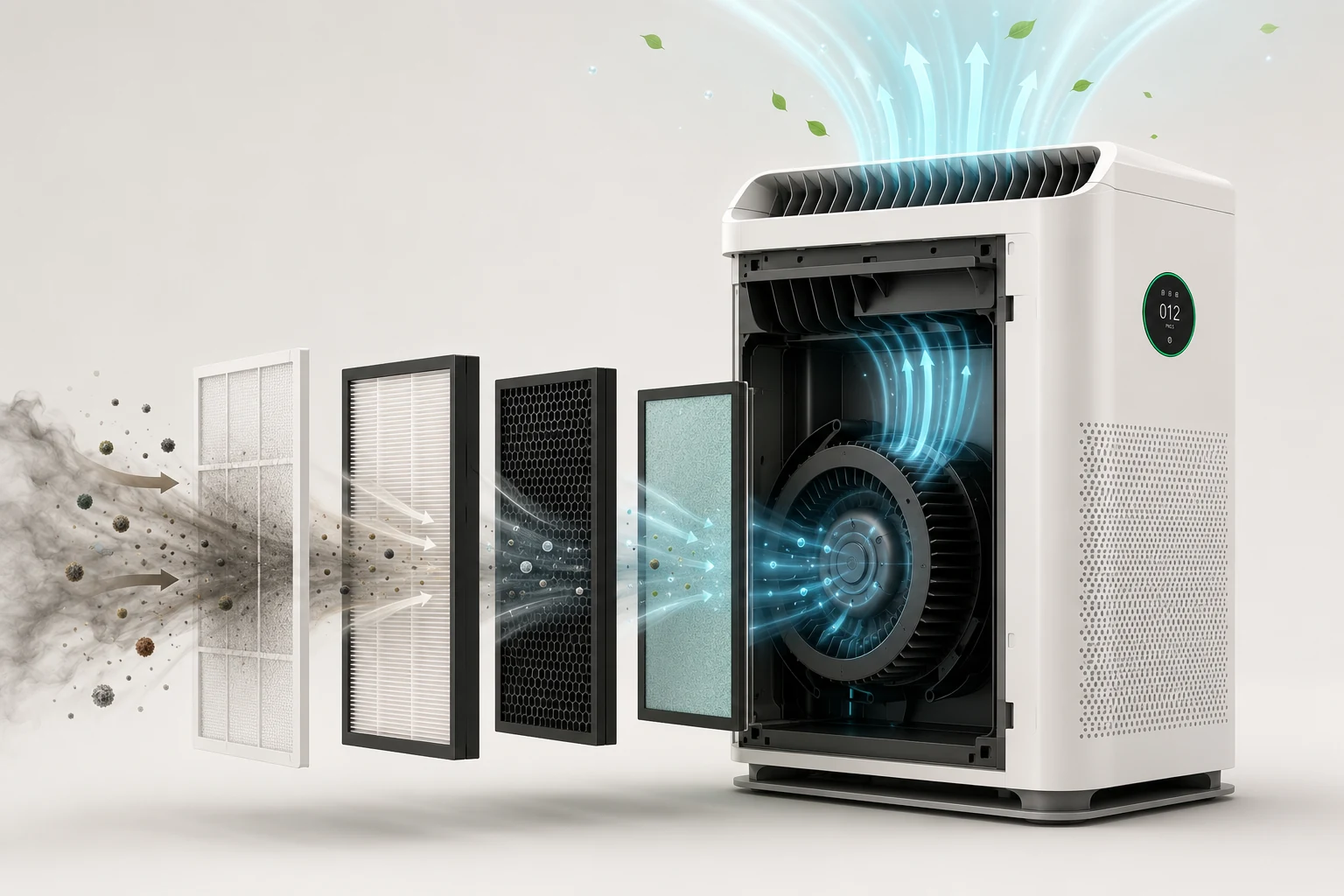
H14 has higher filter efficiency - but that is not the whole buying decision
Under EN 1822 classification, H13 and H14 are both high-efficiency particulate air filter classes. H13 has an integral efficiency of at least 99.95%, while H14 reaches at least 99.995% at the standard's relevant test basis. On paper, H14 is therefore the more efficient filter class. But an air purifier is a complete system, not a loose filter sheet.
What the percentages actually mean
The difference between 99.95% and 99.995% looks small, but H14 permits one-tenth the penetration of H13 at the integral classification level: up to 0.005% versus up to 0.05%. This distinction matters in tightly controlled applications. For a consumer room purifier, however, the practical result also depends on how much room air the fan can move through the filter, whether air bypasses the filter, and how often the room's air is processed.
Why a 'better' filter can create a worse purifier if the system is poorly designed
Denser filtration can increase resistance to airflow. A manufacturer must balance filter efficiency, filter area, fan capability, noise, energy use and sealing. If a high-grade filter is paired with insufficient airflow, the machine may deliver less clean air to the room than a well-engineered system using a different filter configuration. That is why CADR is such a valuable whole-device metric for particle cleaning.
HEPA grade and CADR answer different questions
HEPA classification asks how efficiently the filter captures particles under its test conditions. CADR asks how much filtered air the complete air cleaner delivers for particular particle categories. Consumers should avoid treating either number in isolation. A credible purifier specification should make it possible to understand both the filtration technology and the rate at which the device can clean the intended room.
Do homes need H14?
There is no universal rule that every home needs H14. The appropriate choice depends on the application, verified machine performance, room size, noise tolerance, filter replacement cost and other design factors. For ordinary residential particle reduction, a well-designed purifier with strong whole-machine performance can be more useful than selecting solely by the highest filter-class label.
Watch the wording on product listings
Terms such as 'HEPA-type', 'HEPA-like' and 'true HEPA' are not substitutes for understanding the actual test standard and whole-device performance. Ask what standard the filter is classified against, whether the claim applies to the filter media or complete product, and what CADR or independently verified room-size performance the machine achieves.
A practical buying checklist
Look for a clearly identified filter specification, credible CADR or room-size performance, good sealing around the filter, replacement-filter availability, acceptable noise at useful fan speeds and transparent maintenance guidance. If gas or odour removal matters, check for a meaningful quantity of suitable gas-phase media rather than assuming a HEPA filter handles gases.
Where AERAKAYU fits
WAZ Pure Living will not label an AERAKAYU model H13, H14 or any other grade until the selected production configuration and supporting documentation justify that exact claim. That distinction matters: trustworthy product education should come before marketing terminology.
Frequently asked questions
Is H14 always better than H13?
H14 has a higher filter-class efficiency under EN 1822, but a complete purifier's usefulness also depends on airflow, CADR, sealing, noise and room sizing.
What is the H13 efficiency?
EN 1822 lists H13 at at least 99.95% integral efficiency, with maximum integral penetration of 0.05%.
What is the H14 efficiency?
EN 1822 lists H14 at at least 99.995% integral efficiency, with maximum integral penetration of 0.005%.
Should I choose a purifier only by HEPA grade?
No. Compare the complete machine, especially CADR, intended room size, filter sealing, noise and replacement costs.
Continue learning
Sources & further reading
- MANN+HUMMEL — EN 1822 classification - HEPA classification framework and H13/H14 efficiency levels.
- U.S. EPA — Guide to Air Cleaners in the Home - Whole-device CADR, airflow and room-sizing guidance.
- AHAM Verifide — Air Filtration Standards - CADR as a measure of filtered-air delivery.
Explore more practical indoor-air guidance in the WAZ Pure Living Knowledge Centre. AERAKAYU product information will be introduced progressively as individual models, specifications and supporting documentation are verified.
Talk to our team →