
Turning two coconut by-products into an interior air-quality material
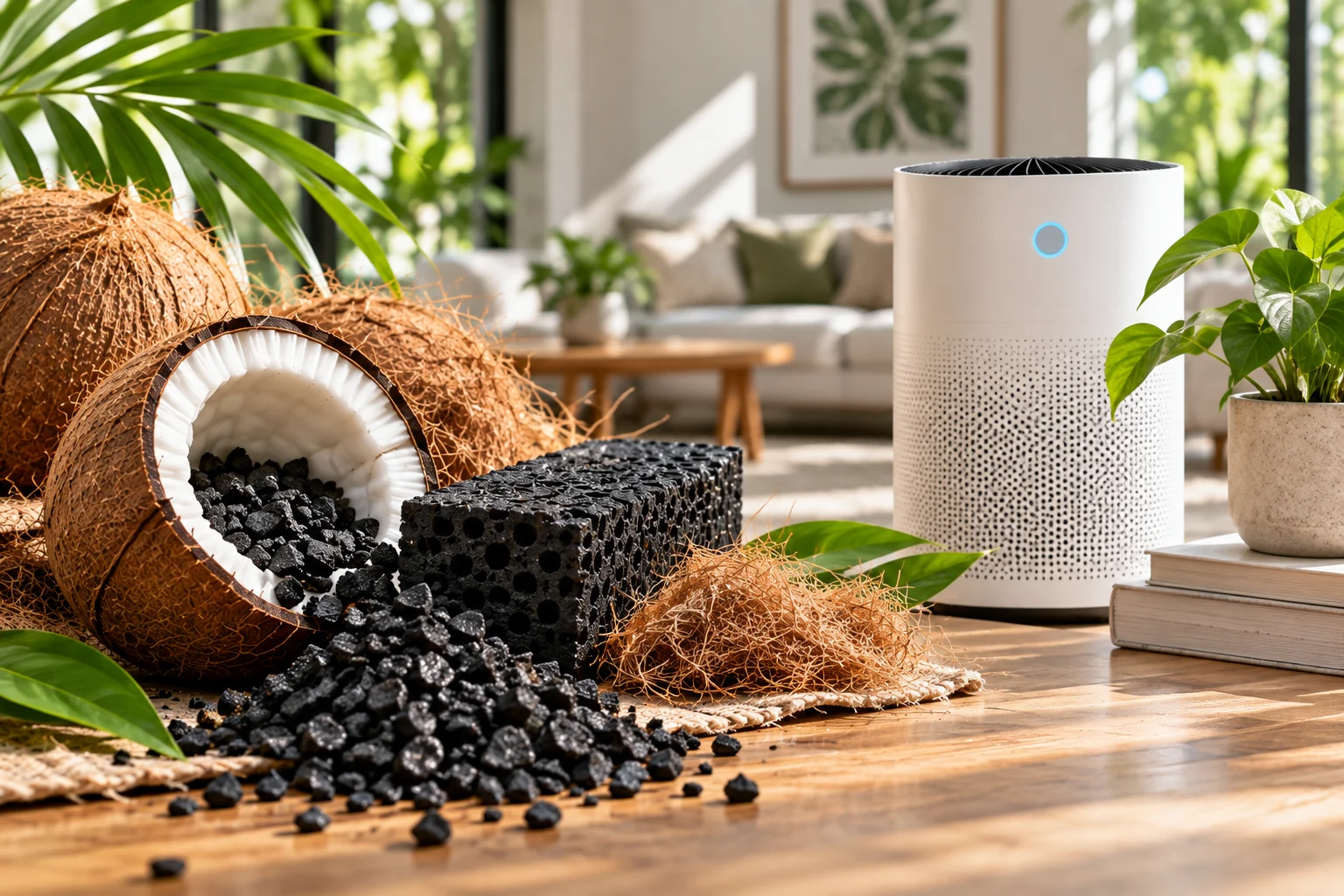
A 2026 Indonesian study developed Coconut Waste Interior Panels using a 50:50 mixture of activated coconut charcoal and coconut fibre, contained in perforated wooden boxes. The idea combines porous carbon adsorption with a fibrous agricultural material in a passive interior element that requires no electricity.
How the researchers tested it
Experiments were conducted in a 27 cubic metre enclosed room under four scenarios: with or without the coconut-waste panels and with or without fan circulation. Mosquito-coil smoke was used as the particle source, and the researchers monitored PM2.5, PM10 and humidity.
The reported particle reductions were notable
Without fan circulation, the study reported PM2.5 falling from 65.67 to 40.27 micrograms per cubic metre and PM10 from 82.73 to 49.93 micrograms per cubic metre, with statistically significant differences. Humidity also decreased significantly under the static condition. The fan-assisted scenario produced a more moderate decrease.
Why this is interesting for Indonesia
Indonesia has abundant coconut-processing residues, including shell and coir. Finding higher-value uses for these materials can connect circular-economy goals with indoor-environment innovation. The study is especially relevant to WAZ because it sits at the intersection of two areas we follow closely: coconut downstreaming and practical indoor-air solutions.
What the study does not prove
This was a controlled-room experiment using a specific panel construction and pollution source. It does not establish that loose coconut fibre, ordinary charcoal or any consumer coconut product will clean a home to the same degree. It also does not show that a passive panel can replace a properly sized mechanical particle purifier.
Passive materials and active filtration solve different problems
A powered purifier deliberately moves large volumes of room air through filtration media. A passive interior panel relies on natural contact between polluted air and its material surface, so the transport mechanism is fundamentally different. The coconut-panel research is best viewed as an intriguing complementary materials concept that deserves further independent and real-world testing.
Frequently asked questions
Did the coconut panels reduce PM2.5 in the study?
Yes. In the reported static test, PM2.5 decreased from 65.67 to 40.27 micrograms per cubic metre. That result applies to the study setup and should not be generalized to every room or coconut material.
What were the panels made from?
The researchers used a 50:50 mixture of activated coconut charcoal and coconut fibre in perforated wooden boxes.
Can coconut panels replace a HEPA purifier?
The study does not establish that. Passive panels and powered mechanical filtration work differently, and more real-world validation is needed.
Continue learning
Sources & further reading
- DIMENSI — Performance of Coconut Waste Interior Panels in Reducing Particulate Matter and Moisture — 2026 Indonesian study of 50:50 activated coconut charcoal and coconut fibre interior panels.
- Garuda — Indonesian national research index record — Bibliographic and abstract record for the same study.
Research summaries are educational and do not constitute medical advice or a product-performance claim for any AERAKAYU model.
Explore evidence-led indoor-air guidance in the WAZ Pure Living Knowledge Centre. AERAKAYU product claims will be introduced only as individual model specifications and supporting documentation are verified.
Talk to our team →