
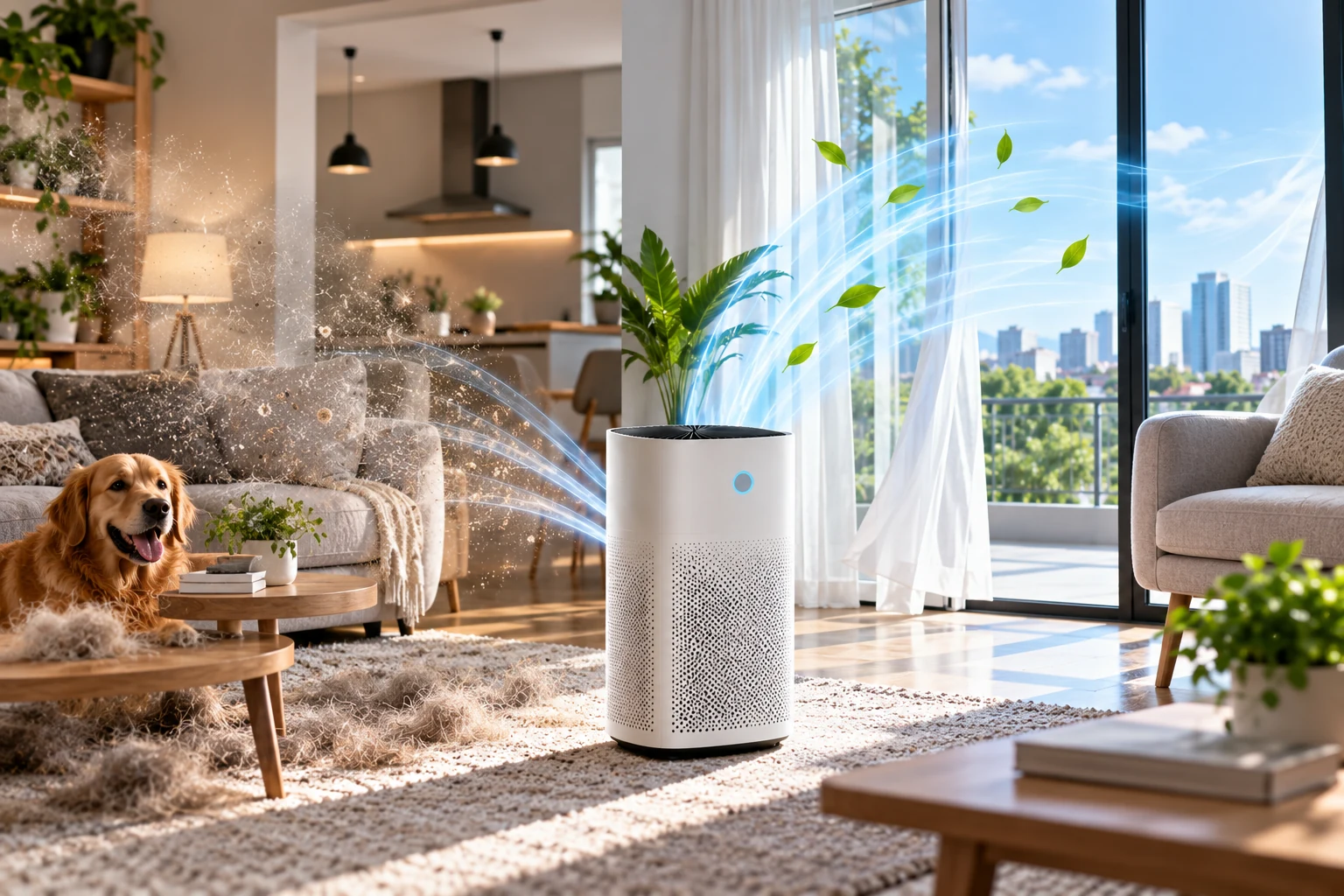
A review built around real homes, not just laboratory tests
University of Toronto researchers identified 41 randomized portable-air-cleaner interventions conducted in homes and reported across 64 articles. Every included intervention measured indoor PM2.5. The review asked a practical question: why does the same basic technology produce very different results once it leaves the laboratory?
The range of PM2.5 reduction was huge
Across the reviewed interventions, average indoor PM2.5 reductions ranged from 6.3% to 82.7%. Absolute reductions ranged from 1.2 to 54.9 micrograms per cubic metre. That spread is a powerful reminder that a purifier does not operate in a vacuum: the building, pollution source and user behaviour become part of the system.
Nominal CADR did not neatly predict the observed reduction
The review found that measured concentration reductions were frequently lower than expected from nominal CADR relative to room volume. The authors suggested possible reasons including operation at lower fan speeds than reported and room dimensions underestimating the effective volume of connected spaces. CADR remains useful, but its real-world effect depends on how the device is actually deployed.
Windows and room type changed performance
Effectiveness was greater when windows were closed and in bedrooms compared with living rooms. This makes physical sense: open windows can continuously introduce outdoor particles, while larger or more connected living areas can increase the volume of air that must be cleaned. A purifier sized for a closed bedroom may not deliver the same percentage reduction in an open-plan living space.
Outdoor pollution changes the opportunity for reduction
Absolute PM2.5 reductions tended to be greater, and more variable, when ambient PM2.5 was higher. In places where outdoor pollution infiltrates indoors, the starting concentration and infiltration rate therefore influence what a purifier can achieve. This is especially relevant when interpreting purifier performance in urban Indonesian homes.
The practical lesson: size, place and operate the purifier for the real room
Choose a purifier using the room you actually want to clean, not an optimistic floor-area claim. Run it at a speed you can tolerate for long periods, avoid blocking the inlet or outlet, and recognize that open doors and windows can change the effective cleaning volume. Real-world performance is a system outcome.
Frequently asked questions
Why can two homes get different results from the same purifier?
Room volume, connected spaces, windows, outdoor pollution, indoor sources, fan speed, placement and runtime can all change the measured result.
Does a higher CADR guarantee a fixed percentage reduction?
No. CADR describes clean-air delivery under test conditions; the concentration reduction in a real home also depends on pollutant entry, room mixing and operation.
Should windows be closed when using a purifier for outdoor PM2.5?
When outdoor particle pollution is high, closing windows can reduce continued particle entry; the 2026 review found higher purifier effectiveness in interventions with closed windows.
Continue learning
Sources & further reading
- Environmental Science & Technology — Contextual Factors That Impact the Performance of Portable Air Cleaners: A Critical Review — 2026 critical review of 41 randomized home interventions reported in 64 articles.
- PubMed — Mendell, Lee & Siegel (2026) — Indexed abstract and bibliographic record for the review.
Research summaries are educational and do not constitute medical advice or a product-performance claim for any AERAKAYU model.
Explore evidence-led indoor-air guidance in the WAZ Pure Living Knowledge Centre. AERAKAYU product claims will be introduced only as individual model specifications and supporting documentation are verified.
Talk to our team →