
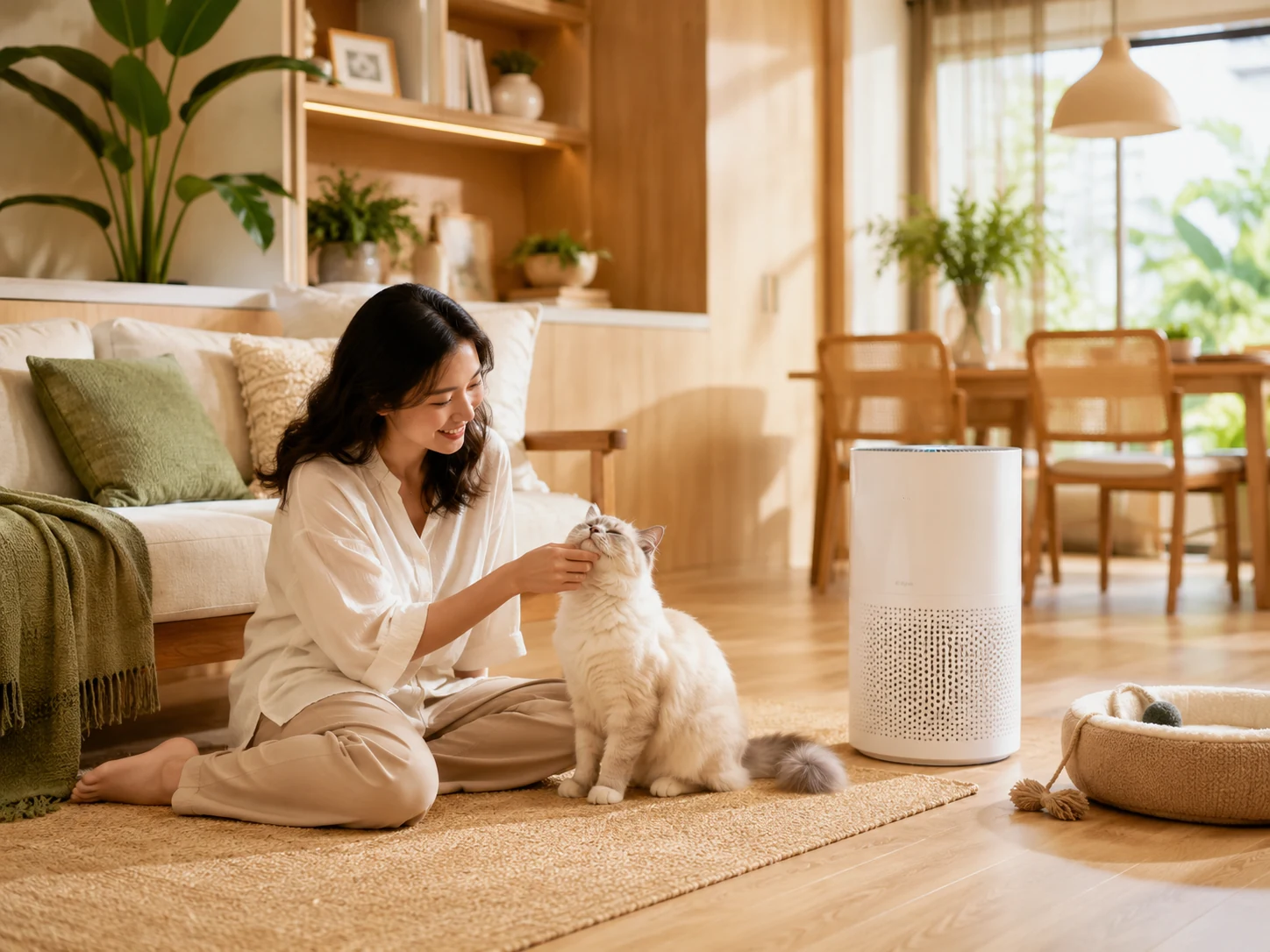
Yes - but hair, dander and odour are three different problems
An air purifier can help reduce some airborne material associated with pets, but it is important to separate visible hair, microscopic dander and gaseous odours. They behave differently and are not all controlled by the same filter.
Pet hair
Large pet hairs usually settle quickly onto floors, furniture and fabrics. A purifier may catch some hair that becomes airborne and reaches its intake, especially if it has a useful pre-filter, but it should not replace vacuuming, brushing, upholstery cleaning or floor care. For pet households, an accessible washable or cleanable pre-filter can be valuable because it protects the finer downstream filter from larger debris.
Pet dander
Dander consists of small biological particles shed from animals. Some can remain airborne, while much allergenic material settles onto surfaces. EPA notes that animal dander and other larger allergens cannot be removed by an air cleaner while they are settled; they must first become airborne or resuspended and reach the purifier. This is why filtration and surface cleaning work together.
Odours are not particles
A particle filter does not automatically remove pet smells. Odours involve gases and volatile compounds, so a purifier intended to address them needs appropriate gas-phase media. Activated carbon is commonly used, but the amount and design matter. EPA notes that activated carbon can be effective when a substantial amount of material is used.
What a pet-focused purifier should prioritise
For a pet household, useful design priorities include strong particle CADR for the room size, an effective pre-filter for larger debris, high-efficiency downstream particle filtration, meaningful gas-phase media if odour control is claimed, easy filter access, sensible noise levels and replacement filters that are readily available.
Placement matters
A purifier should have space around its air intake and outlet and should be placed where air can circulate. Hiding it behind a sofa or placing it where pet hair completely blocks the intake can reduce performance. In a home where the pet spends most of its time in one room, that room may be the logical priority.
What an air purifier cannot replace
Regular vacuuming, washing pet bedding, cleaning hard surfaces, grooming, litter-box hygiene and addressing the source of strong odours remain important. If someone has significant allergies or respiratory symptoms, product selection should not replace advice from an appropriate healthcare professional.
Why AERAKAYU PET is a separate concept
A pet-oriented purifier should not simply be a standard machine with a pet label. The future AERAKAYU PET concept gives WAZ Pure Living a framework to evaluate pre-filtration, particle cleaning, odour media, cleanability and filter economics specifically for pet households. Final claims will depend on the verified production specification.
Frequently asked questions
Will an air purifier remove pet hair from my floor?
No. It may capture some airborne hair, but settled hair still requires vacuuming and cleaning.
Can HEPA filtration help with pet dander?
High-efficiency particle filtration can capture airborne dander that reaches the purifier, but it cannot remove allergen particles while they remain settled on surfaces.
Will HEPA remove pet smells?
HEPA is designed for particles, not gases. Odour control generally requires suitable gas-phase media such as activated carbon.
Should I place the purifier next to the pet bed?
It can be useful to operate the purifier in the room where the pet spends significant time, but maintain clear airflow around the intake and outlet.
Continue learning
Sources & further reading
Explore more practical indoor-air guidance in the WAZ Pure Living Knowledge Centre. AERAKAYU product information will be introduced progressively as individual models, specifications and supporting documentation are verified.
Talk to our team →