
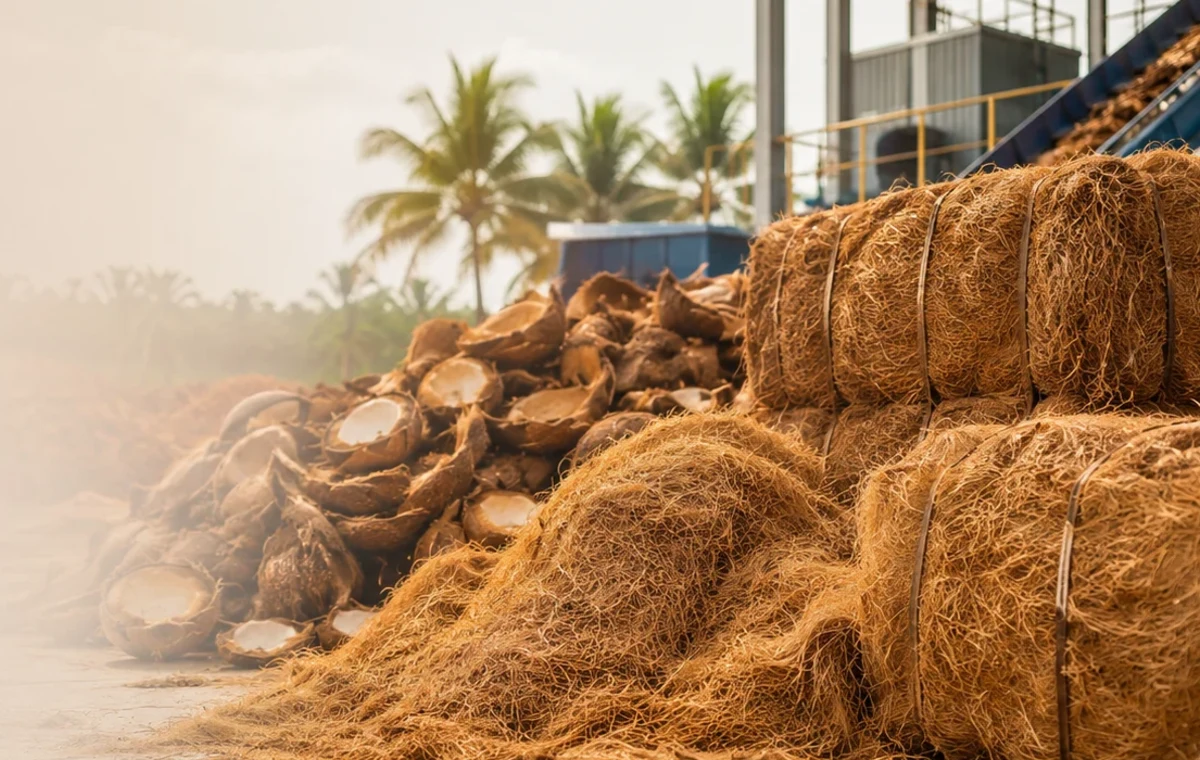
1. The husk is the starting point
The fibrous outer husk surrounding a coconut is the raw material for coir. FAO describes coir fibres as being extracted from coconut husks and notes long-established uses such as brushes, brooms, ropes, yarns, mats and mattress padding. Commercial processing methods and the characteristics of the resulting fibre can vary with maturity, geography and processing route.
For trade purposes, the important point is that “coconut husk” should not be treated as a single uniform commodity. Processing separates different fractions and creates products aimed at different markets.
2. Fibre and pith follow different commercial pathways
When husk is processed, longer fibre can be separated for fibre-based products while the shorter material and pith fraction can be screened and prepared for horticultural use. The Coir Board describes coir pith as the spongy material that binds fibre in the husk and notes its use as a soil-less growing medium and soil-conditioning material. Coconut husk chips are also used in horticultural applications.
Buyer takeaway: “coir”, “coconut fibre”, “cocopeat/coir pith” and “coconut husk chips” are related, but they are not interchangeable product descriptions. A sourcing requirement should identify the intended application and the specification that matters for that application.
3. Fibre can move into multiple downstream markets
Traditional fibre markets include rope, cordage, mats, brushes and cushioning. Coir has also developed into technical and horticultural applications such as geotextiles, garden articles and other fibre-based materials. This widening application base is one reason it is useful to think in terms of a value chain rather than a single fibre product.
Different downstream users may care about different attributes: fibre length, cleanliness, moisture, preparation method, bale format, contamination controls, documentation, packaging or performance in a specific manufacturing process. Those requirements should be confirmed between buyer and supplier rather than assumed from a generic product name.
4. The pith fraction became a commercial growing-media input
Coir pith — commonly marketed in international horticulture as cocopeat or coir substrate — has become an important growing-media input. Depending on the target market, buyers may discuss parameters such as electrical conductivity (EC), pH, moisture, particle distribution, expansion, compression format and washing or buffering practices.
Those parameters require careful context. A quoted number is only useful when the buyer and supplier agree on the product condition and test method. CTN will cover these subjects separately in its technical buyer guides rather than treating all cocopeat as identical.
5. Indonesia is pushing further downstream
Indonesia's Ministry of Agriculture has explicitly identified cocopeat and coconut fibre among the coconut-derived products targeted through its downstreaming programme. In January 2026, the ministry said the national coconut development strategy was intended to strengthen processing, value addition and market access alongside upstream production improvements.
For international buyers, that direction matters because Indonesia is not only a source of whole coconuts. The commercial opportunity increasingly includes processed coconut materials and product-specific supply chains.
6. What buyers should ask before sourcing
A useful coir-related enquiry should normally move beyond “price per tonne”. Depending on the product, buyers may need to establish:
- exact product type and intended application;
- grade, dimensions or fibre characteristics where relevant;
- moisture, EC, pH or other agreed quality parameters where relevant;
- packing and compression format;
- monthly or shipment quantity;
- required origin, phytosanitary, testing or destination-market documents;
- Incoterm and destination port;
- sample, inspection or pre-shipment expectations.
Not every parameter applies to every coir product. The purpose of a structured requirement is to identify what actually matters for the intended use.
7. The value chain is also a sourcing map
For CTN, the coir value chain is useful because it connects buyer requirements with the correct part of the Indonesian supply ecosystem. A nursery buyer seeking coir pots has a different requirement from a substrate company sourcing low-EC cocopeat, an industrial user sourcing fibre, or a landscaping buyer considering coir-based erosion-control materials.
That distinction is central to WAZ Coconut Trade Network's operating role: helping structure the requirement, connect relevant parties and coordinate commercial discussion without implying that WAZ itself manufactures, certifies, owns stock or guarantees product suitability.
Sources & further reading
This article is original CTN editorial content informed by the sources below. Source links are provided for transparency and further reading.
- Food and Agriculture Organization of the United Nations (FAO), Coconut — Tree of Life: Coir.
- FAO, Coconut Post-harvest Operations — Coconut Fibre Products.
- Coir Board, Government of India, Natural Coir Products and Applications.
- Directorate General of Estate Crops, Ministry of Agriculture, Republic of Indonesia, Indonesia Bidik Kejayaan Kelapa dengan Hilirisasi Perkebunan, 21 January 2026.
Have a coconut-product sourcing requirement?
Tell CTN the product, application, target specification, quantity and destination. WAZ can help structure the requirement and connect it with relevant Indonesian supply opportunities.
Submit a Sourcing RequirementIntroduce Supplier Capability