
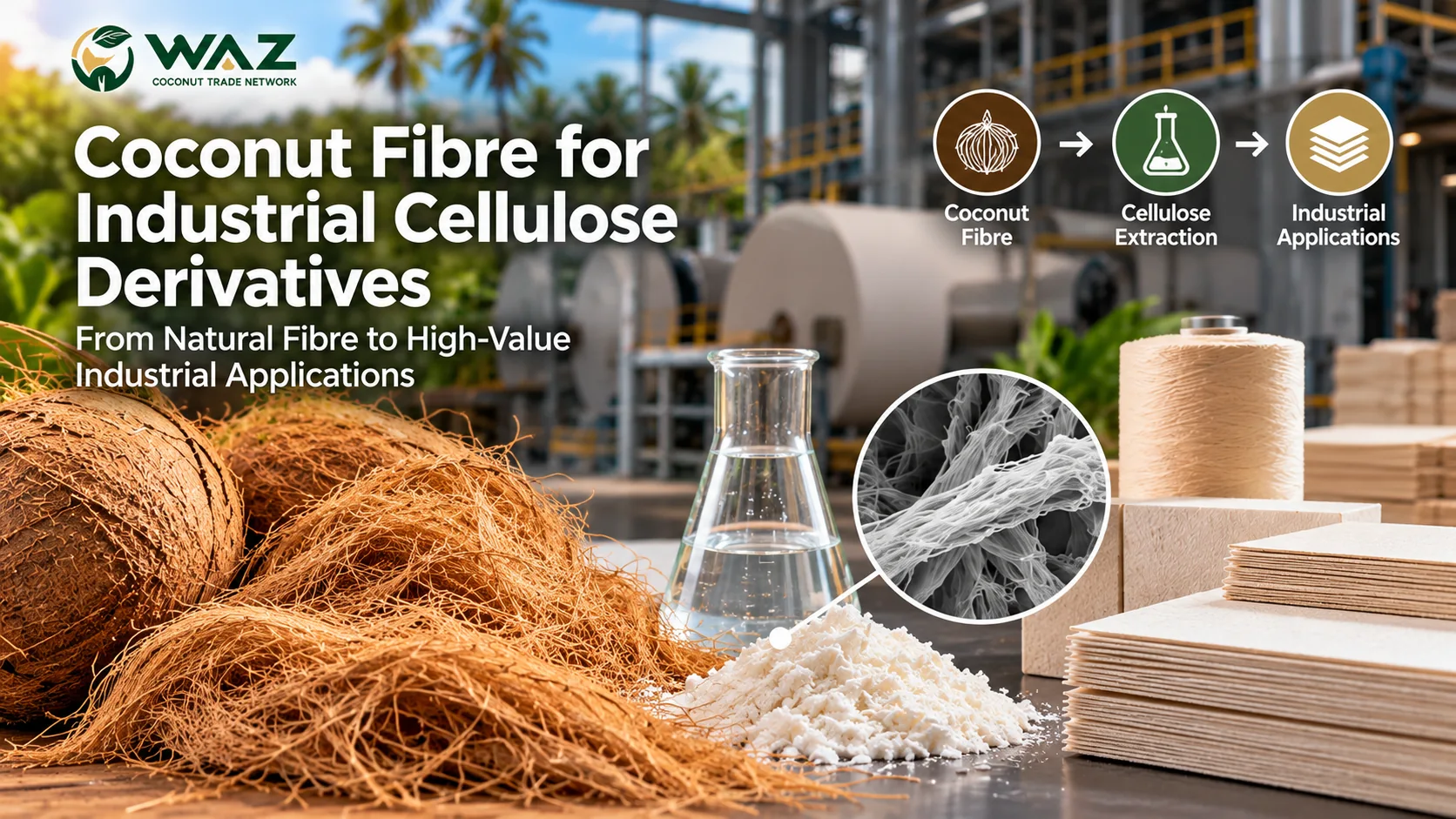
New work on coconut-fibre pretreatment and CMC synthesis points to chemical-industry possibilities beyond conventional coir products.
1. What is CMC?
Carboxymethyl cellulose (CMC) is a chemically modified cellulose derivative used in a range of industrial formulations. Its usefulness depends on grade, purity, substitution characteristics and application-specific standards. It should not be assumed that laboratory CMC is suitable for food, pharmaceutical or personal-care use.
2. Why coconut fibre is interesting
Coir contains cellulose but also substantial lignin and hemicellulose. Those components make direct processing challenging, so pretreatment and purification are central to producing a useful cellulose feedstock.
3. What the 2026 study investigated
Researchers writing in the International Journal of Biological Macromolecules evaluated sequential autohydrolysis, alkaline extraction and organosolv treatment followed by chemical modification. They reported increasing cellulose content and successful CMC formation under their experimental conditions. The results describe a laboratory processing route, not an existing WAZ production capability.
4. Indonesian research provides local relevance
A 2024 study involving Indonesian research institutions examined CMC synthesis from coconut fibre collected in South Tangerang for potential bioplastics applications. This makes the topic relevant to Indonesia’s wider coconut-downstreaming discussion, although commercial scale-up remains a separate challenge.
5. The real industrial questions
Before scale-up, manufacturers must assess chemical consumption, solvent recovery, water and wastewater management, product purity, process yield, energy requirements, cost and consistent raw-material quality. Chemical modification can carry environmental burdens even when the original feedstock is renewable.
6. What buyers and suppliers can learn
Potential fibre suppliers should focus on cleanliness, composition, moisture, traceability and repeatable grading. Researchers and chemical manufacturers will need much more detailed specifications than conventional rope or brush-fibre buyers.
7. CTN perspective
This is a materials-innovation insight, not a claim that CMC made from Indonesian coconut fibre is available through WAZ. Buyers can share relevant raw-material or technical sourcing requirements for exploration.
Research-stage application: do not infer certified product performance, commercial availability, or environmental superiority without application-specific testing.
Sources & further reading
Have a related sourcing requirement?
Share your application, material grade, quantity, destination and testing requirements. WAZ can help structure a discussion with potential suppliers; availability and specifications must be independently confirmed.
Submit Requirement