
Researchers have converted pretreated coconut coir pith into fermentable sugars and PHBV polymer. Commercial scale and end-of-life claims still require evidence.
1. Why coir pith is being studied
Coconut coir pith is a lignocellulosic residue best known as a growing-media ingredient. Researchers are also exploring it as a carbon source for microbial polymer production. That is a different value chain from simply moulding coir into a plant pot.
2. PHBV is made through a conversion process
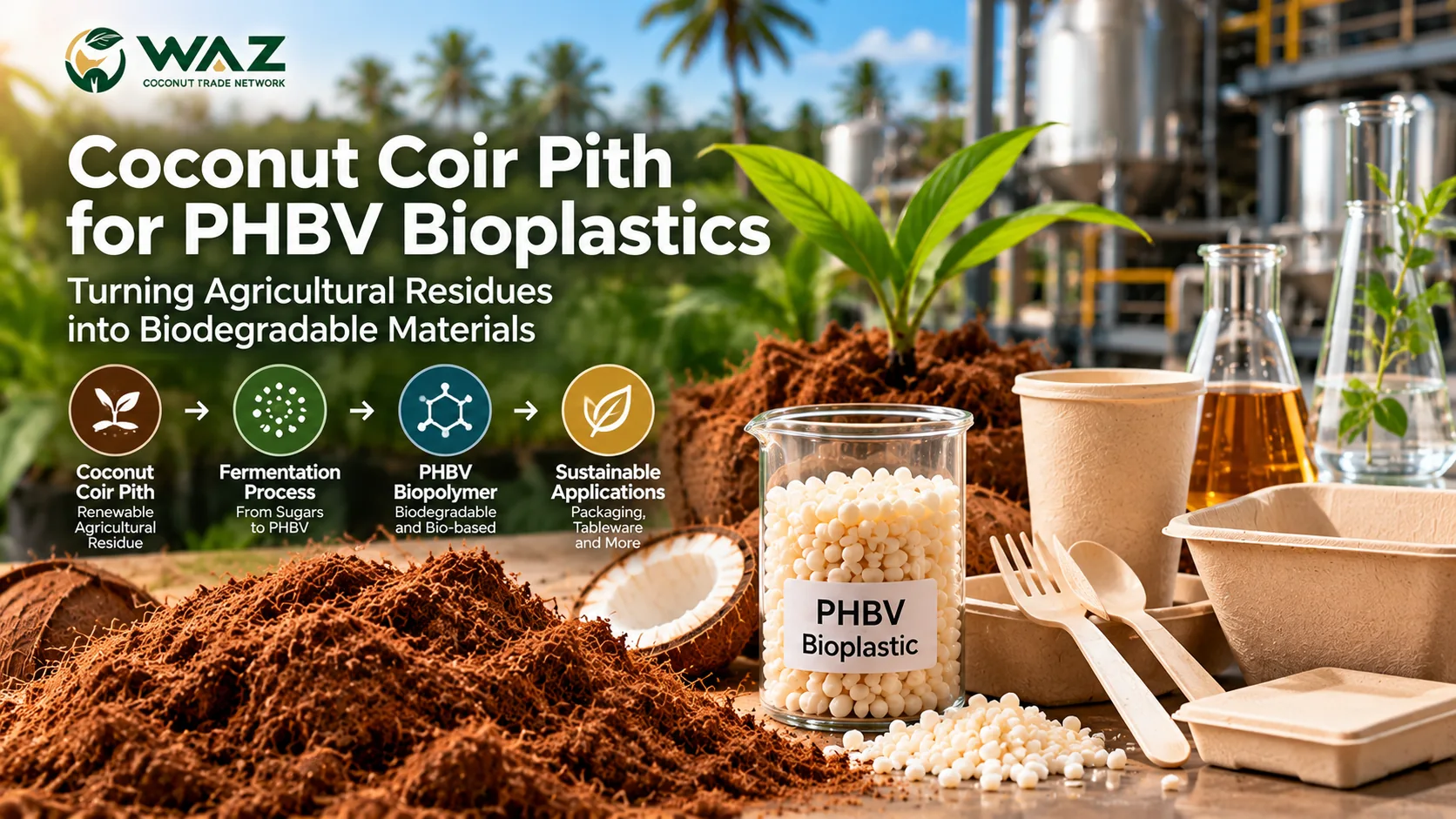
Poly(3-hydroxybutyrate-co-3-hydroxyvalerate), or PHBV, is a microbial polyester. In the 2026 study, coir pith underwent pretreatment and enzymatic hydrolysis to release sugars. A bacterial fermentation process then converted part of that feedstock into PHBV. The polymer is not directly extracted from raw coir.
3. What the 2026 study found
A Journal of Cleaner Production paper investigated pretreatment, enzyme use and fed-batch fermentation with Brevibacillus invocatus. The authors reported PHBV production under optimised experimental conditions and confirmed polymer identity through analytical techniques. These results demonstrate technical feasibility within the studied system; they do not establish a competitive industrial plant.
4. Biodegradable does not mean litter-safe
PHBV may biodegrade under certain conditions, but the rate and completeness depend on polymer formulation, product thickness and the disposal environment. Compostability or marine-biodegradation claims require appropriate tests and certification for the specific finished product.
5. What industrial buyers should assess
Commercial decisions depend on substrate availability, pretreatment chemicals, enzyme recovery, fermentation productivity, polymer recovery, material properties, energy, water, wastewater and the price of competing feedstocks. A life-cycle assessment would need to account for the complete process.
6. Indonesia’s potential role
Indonesia’s coconut sector could offer coir-pith feedstock for future biotechnology projects. For now, CTN treats PHBV as a research-led downstream opportunity, not a product currently listed as available for supply.
Research-stage application: do not infer certified product performance, commercial availability, or environmental superiority without application-specific testing.
Sources & further reading
Have a related sourcing requirement?
Share your application, material grade, quantity, destination and testing requirements. WAZ can help structure a discussion with potential suppliers; availability and specifications must be independently confirmed.
Submit Requirement